
Journal
Premium Fragrance Manufacturing: Planning Lead Times for a Seasonal Collection
A seasonal premium collection fails on the calendar more often than on the scent. Premium positioning pulls the schedule in two opposite directions: the product needs more development and sampling time because the raw materials and the finish are judged against a higher standard, while the seasonal window allows less slack because the launch date is fixed by the market. The practical consequence is that every decision that can be locked early, concentrate direction, packaging architecture, evaluation protocol, should be, because the season will not wait for the factory.
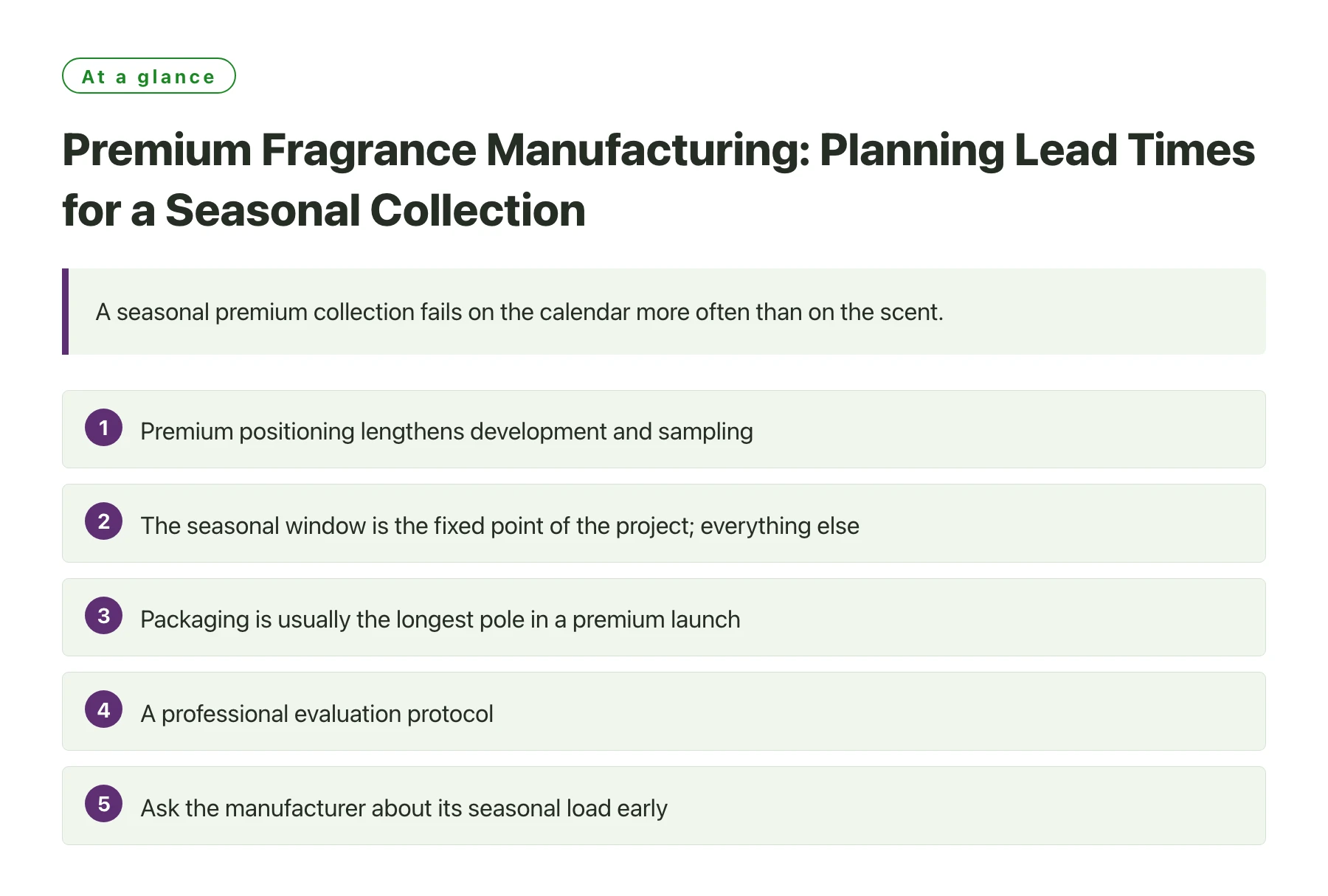
Key takeawaysPremium positioning lengthens development and sampling, not because the work is harder but because the acceptance standard is higher. · The seasonal window is the fixed point of the project; everything else, including the manufacturer's production slot, has to fit around it. · Packaging is usually the longest pole in a premium launch; the scent can be finalised while mould and decoration decisions are still running. · A professional evaluation protocol, run by trained noses on both sides, is what keeps sample approvals from drifting across the seasons. · Ask the manufacturer about its seasonal load early; premium batches are smaller, but they still queue behind the high season.
Seasonal collections get planned twice: once on a nice timeline nobody follows, and once for real when the freight date refuses to move. The second plan is the one that matters.
This guide is written from the product developer's desk, where the same question returns every quarter: what has to be true six months before the launch so that the collection ships on time. It is not a list of standard durations, it is the sequence of decisions that keeps a premium project on its calendar.
What premium changes in the calendar
The raw materials of a premium fragrance are not measured by a different clock; the standards they are held to are. Evaluation is stricter, raw-material certificates are checked more carefully, and the finished batch is sniffed and measured against a retained reference rather than against a note in a file. All of that costs calendar weeks, not days.
There is also a regulatory floor under any of it: before a cosmetic fragrance can be placed on the EU market, the responsible person must hold a product information file with a safety assessment [1], and the concentrate has to respect the IFRA restrictions on fragrance ingredients [2]. Premium positioning does not add these steps; it just makes it more painful to discover them late.
Where the premium calendar really differs is upstream of production. The scent direction, the packaging architecture and the evaluation protocol are decided earlier, and buffers are scheduled in, instead of the schedule being whatever space is left between other milestones. On the line itself, the checkpoints that matter in luxury fragrance production, from material intake to the finished bottle, are the discipline buyers usually study while the protocol is being drafted quality control in luxury fragrance production.
Decisions that set the premium pace
| Decision | Why it is expensive to change late | Lock it by |
|---|---|---|
| Concentrate direction | A premium accord is built around specific materials; swapping them after evaluation restarts the whole judgement | Before packaging tooling starts |
| Evaluation protocol | The brand and the factory must sniff against the same retained references, or approvals drift | The first sampling round |
| Packaging architecture | Moulds, finishes and decoration have their own queues; revisions land at the back of them | Before production is booked |
| Batch size and slot | Premium runs are small but still need a reserved production slot inside the factory's season | Two to three months ahead |
| Compliance pack | Safety assessments and notifications take their own lead time in every market | In parallel with development |
Notice that the scent itself is rarely the longest pole. Packaging and the compliance file are, because they run on queues of their own that do not compress when the season does.
The seasonal window is the fixed point
A collection aimed at, say, the autumn holiday window has a ship date set by retail calendars, not by the supplier. Once that date is fixed, the plan has to work backwards from freight and customs, then from production, then from stability and evaluation, the same discipline as any launch, but with less forgiveness, because a late premium collection misses the moment it was built for.
This is where the choice of partner shows. A manufacturer that works across the fine-fragrance calendar will say plainly where you sit in the seasonal load and will name the actual production slot instead of offering a generic promise. Some brands prefer to keep development and production with a manufacturer for luxury fragrance brands precisely so that the slot and the development milestones are planned by the same people.
Sampling discipline is the quiet lead-time lever
Agree the reference before the first sample
The most common source of a slipped season is not a slow factory; it is an approval process where each round changes direction slightly. Fix the evaluation criteria in the first meeting: which attributes are judged, on what scale, by whom, and against which retained physical reference. A retained sample with a date and a batch number ends debates that a photograph or a memory cannot [3].
Train the noses that approve the product
If three people on the brand side smell three different things, the project follows the loudest opinion and drifts. It is worth investing in the team's ability to evaluate consistently; dedicated professional scent training exists for exactly this, and a brand that evaluates the same way its manufacturer does cuts whole rounds of re-sampling.
Set the “good enough to ship” bar in writing
Premium teams habitually chase a perfect round that never arrives. Decide at the start which attributes must be at final standard for the launch and which may be tightened later; otherwise the third sampling round becomes the sixth, and the production slot quietly moves.
A premium seasonal collection is a calendar problem with a scent attached. The formula can be improved later; the launch date cannot. Decide what “good enough to ship” means at the start, write it down, and treat every deviation from it as a schedule decision rather than a taste decision.
Sources
- European Commission: Cosmetic Products — Specific Topics —— EU pages covering specific cosmetics topics such as product claims, nanomaterials and animal-testing rules.
- IFRA Standards Library (International Fragrance Association) —— The IFRA Standards Library lists the restrictions the fragrance industry applies to individual fragrance ingredients, based on safety assessments; it is the reference point for compliant fragrance formulation.
- SGS: Cosmetics, Personal Care & Household Testing —— Testing, inspection and certification services for cosmetics and personal care, including microbiological, stability and safety testing aligned with cosmetics GMP.
Frequently asked questions
Why do premium fragrances need more lead time than standard ones?
Because the acceptance standard is higher, not because the process is slower. More sampling rounds, stricter raw-material checks and more careful batch evaluation all consume calendar time, and that time has to be booked rather than hoped for.
How far ahead should a seasonal collection be planned?
A sensible starting point is six to nine months before the ship date for a first seasonal collection, with the manufacturer's written slot, the packaging queue and the stability window confirmed against an actual calendar rather than a template.
What is the most common reason a seasonal drop slips?
Approval drift: each sample round changes direction slightly until the season forces a decision, and the final round lands after the production slot was lost. Fixed evaluation criteria and retained references prevent most of it.
Do smaller premium batches get faster production slots?
Smaller volumes take less machine time, but a run still needs a reserved slot, a set-up and a QC release. Size shortens the run, not the queue; request the slot in writing well ahead of the season.
What compliance documents does a premium fragrance need before launch?
A safety assessment and product information file for regulated markets such as the EU, the concentrate's IFRA compliance statement, and any market-specific notification. Those run in parallel with development and typically take weeks of their own.
Ready to put your brand on screen?
Thirty minutes with a senior creative producer — no pitch deck, just an honest read on your brief and what broadcast-quality film could do for it.