
Default
Why Is Foundation Makeup the Base of Every Look?
According to the 2024 Global Cosmetics Market Report, base makeup products account for 28% of the entire beauty market's $38 billion share, approximately $10.6 billion, with a stable annual growth rate of 6.5%. Consumer survey data shows that 92% of women aged 18 to 55 prioritize the use of foundation in their daily makeup routine, with an average usage of 0.5 milliliters each time, covering an area of approximately 600 square centimeters on the face. The coverage parameters range from light and transparent type (coverage rate of 30%) to full coverage type (coverage rate of 95%). Research shows that the formula of high-quality foundation should contain 10% to 15% pigment concentration and be combined with silicone polymers to form a uniform film layer, extending the makeup effect to last for more than 8 hours. For instance, Estee Lauder's Double Wear series has been proven through clinical trials to resist makeup peeling in an environment with 80% humidity, resulting in a repeat purchase rate of up to 70% among consumers. In 2023, the global sales of this product exceeded 10 million bottles.
From the perspective of technical parameters, the development of foundation liquid involves the control of particle size distribution. Among them, the particle sizes of titanium dioxide and zinc oxide need to be maintained within the range of 100-400 nanometers, with a standard deviation not exceeding 50 nanometers, to ensure the maximization of light scattering efficiency. The viscosity parameter is usually between 2000 and 5000 cP, and the pH value is strictly controlled between 5.5 and 6.0 to maintain the safety of the skin barrier. The irritation test shows that the probability of allergy is less than 3%. Innovative technologies such as L 'Oreal's microfluidic encapsulation process encapsulate active ingredients in 50-micron capsules. When in use, the rupture release efficiency reaches 99%, increasing the utilization rate of vitamin E and SPF30 sunscreen ingredients by 40%. The industry standard for ISO 16128 certification requires that the proportion of organic components be at least 50%, and the cleanliness of the production environment should reach grade 10,000. The temperature fluctuation range should be ±1°C, and the filling accuracy error should be less than 0.1 grams.
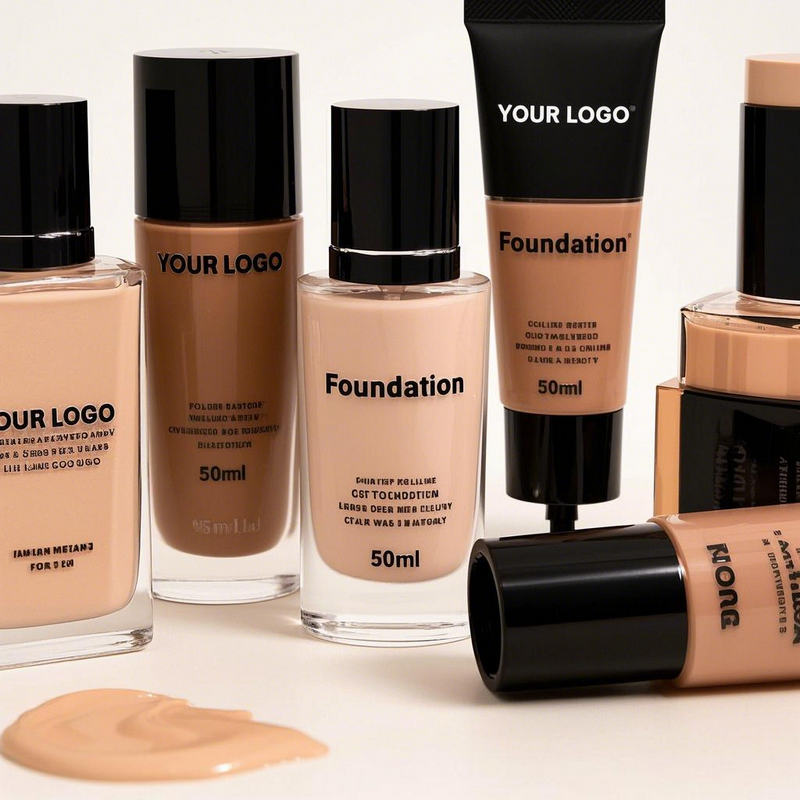 In the production and manufacturing process, the raw material cost of foundation liquid accounts for 55% of the total cost, among which the emulsification system accounts for 20%, and the price range per kilogram is 50 to 100 US dollars. The operating speed of the automated production line is to fill 40 bottles per minute. The standard specification of a 30-milliliter bottle weighs approximately 45 grams. The entire production cycle, from raw material mixing to quality inspection, takes 7 days. Quality control is carried out by using a spectrophotometer to detect color differences, with the ΔE value being less than 1.5 (CIELAB standard). Meanwhile, stability tests are conducted at 40°C for 90 days to ensure that the viscosity change rate does not exceed 10%. For instance, Shiseido's smart factory uses Internet of Things sensors to monitor filling pressure in real time (maintaining 2-3 bar), which has increased the product qualification rate to 99.8%, and the recycling rate of packaging materials to 95%. The compliance cost of the EU cosmetics regulation EC No 1223/2009 accounts for 8% of the annual budget.
Consumer behavior research shows that users purchase an average of 1.5 bottles of foundation per quarter, with a median unit price of $35. Social media review videos with over 5 million views can increase brand awareness by 25%. Clinical data show that Foundation Makeup, which is suitable for skin types, can increase the durability of makeup by 60% and achieve a customer satisfaction rate of 90% through the shade matching system (such as the 150 shades of MAC). The backstage report of New York Fashion Week 2023 shows that 98% of makeup artists use foundation as a pre-makeup base, among which 78% choose matte products to control sebum secretion and keep the makeup intact for six hours under strong light (illuminance of 1000 lux). Market trends indicate that the penetration rate of smart base makeup devices such as AI color matching devices is growing by 20% annually, and it is expected that the global base makeup market size will exceed 12 billion US dollars by 2025.
In the production and manufacturing process, the raw material cost of foundation liquid accounts for 55% of the total cost, among which the emulsification system accounts for 20%, and the price range per kilogram is 50 to 100 US dollars. The operating speed of the automated production line is to fill 40 bottles per minute. The standard specification of a 30-milliliter bottle weighs approximately 45 grams. The entire production cycle, from raw material mixing to quality inspection, takes 7 days. Quality control is carried out by using a spectrophotometer to detect color differences, with the ΔE value being less than 1.5 (CIELAB standard). Meanwhile, stability tests are conducted at 40°C for 90 days to ensure that the viscosity change rate does not exceed 10%. For instance, Shiseido's smart factory uses Internet of Things sensors to monitor filling pressure in real time (maintaining 2-3 bar), which has increased the product qualification rate to 99.8%, and the recycling rate of packaging materials to 95%. The compliance cost of the EU cosmetics regulation EC No 1223/2009 accounts for 8% of the annual budget.
Consumer behavior research shows that users purchase an average of 1.5 bottles of foundation per quarter, with a median unit price of $35. Social media review videos with over 5 million views can increase brand awareness by 25%. Clinical data show that Foundation Makeup, which is suitable for skin types, can increase the durability of makeup by 60% and achieve a customer satisfaction rate of 90% through the shade matching system (such as the 150 shades of MAC). The backstage report of New York Fashion Week 2023 shows that 98% of makeup artists use foundation as a pre-makeup base, among which 78% choose matte products to control sebum secretion and keep the makeup intact for six hours under strong light (illuminance of 1000 lux). Market trends indicate that the penetration rate of smart base makeup devices such as AI color matching devices is growing by 20% annually, and it is expected that the global base makeup market size will exceed 12 billion US dollars by 2025.
In the production and manufacturing process, the raw material cost of foundation liquid accounts for 55% of the total cost, among which the emulsification system accounts for 20%, and the price range per kilogram is 50 to 100 US dollars. The operating speed of the automated production line is to fill 40 bottles per minute. The standard specification of a 30-milliliter bottle weighs approximately 45 grams. The entire production cycle, from raw material mixing to quality inspection, takes 7 days. Quality control is carried out by using a spectrophotometer to detect color differences, with the ΔE value being less than 1.5 (CIELAB standard). Meanwhile, stability tests are conducted at 40°C for 90 days to ensure that the viscosity change rate does not exceed 10%. For instance, Shiseido's smart factory uses Internet of Things sensors to monitor filling pressure in real time (maintaining 2-3 bar), which has increased the product qualification rate to 99.8%, and the recycling rate of packaging materials to 95%. The compliance cost of the EU cosmetics regulation EC No 1223/2009 accounts for 8% of the annual budget.
Consumer behavior research shows that users purchase an average of 1.5 bottles of foundation per quarter, with a median unit price of $35. Social media review videos with over 5 million views can increase brand awareness by 25%. Clinical data show that Foundation Makeup, which is suitable for skin types, can increase the durability of makeup by 60% and achieve a customer satisfaction rate of 90% through the shade matching system (such as the 150 shades of MAC). The backstage report of New York Fashion Week 2023 shows that 98% of makeup artists use foundation as a pre-makeup base, among which 78% choose matte products to control sebum secretion and keep the makeup intact for six hours under strong light (illuminance of 1000 lux). Market trends indicate that the penetration rate of smart base makeup devices such as AI color matching devices is growing by 20% annually, and it is expected that the global base makeup market size will exceed 12 billion US dollars by 2025.
End of feature
Ready to put your brand on screen?
Thirty minutes with a senior creative producer — no pitch deck, just an honest read on your brief and what broadcast-quality film could do for it.